
Twisted Turtle Cantina
The Twisted Turtle Cantina is a 3D level inspired by action-adventure titles such as Cyberpunk 2077 and Starfield. For this level, I wanted to make it feel alive, grimy, and intriguing to make the player want to explore. Not only did I form every art asset in the level, but I also did some programming to trigger the UI found throughout the level. The end goal was to tell a story through set design.
Software: Procreate, Maya, Adobe Photoshop, Adobe Substance Painter/Designer, Unreal Engine


The following concepts were drawn up to determine the set design for the level, The Twisted Turtle Cantina. In these concepts, I made sure to show how many modular components exist to scale the level.

This image is the first-pass interpretation of the 3D level. Through playtesting and walkthroughs, I realized the level was significantly large and required a lot of scale-down to make it feel more lively. Not only that, but scaling the environment down would allow for the assets to shine in a living way. I really wanted to make this level feel like a cantina without the need for characters.
Dracula's Castle
This 3D multiplayer level was inspired by the verticality and optimization of barriers often found in shooters such as Valorant or Destiny. The final level contains 3 "floors," 4 teleporters leading to new areas, and several choke points designed for multiplayer gameplay.
Software: Procreate, Lyra Editor for Unreal Engine


This level papermap, while simple, lays out a 3D level designed with intention for it to be used in a multiplayer shooter. I tried my best to mimic a figure-8 pattern to give the players a map to cycle through smoothly while also making space for verticality.

Through consistent playtesting, I constantly iterated to include more verticality and unique areas for the players to hide/explore.
Remember
Remember is a 2D, pixel-art game where you play as a character working her day-to-day life. It was inspired by cozy adventure games like Inbento or Stardew Valley. While the jigsaw puzzle mechanics weren't engineered, the level was designed with the intent that it would be made at a later date.
Software: Adobe Photoshop, Construct 3
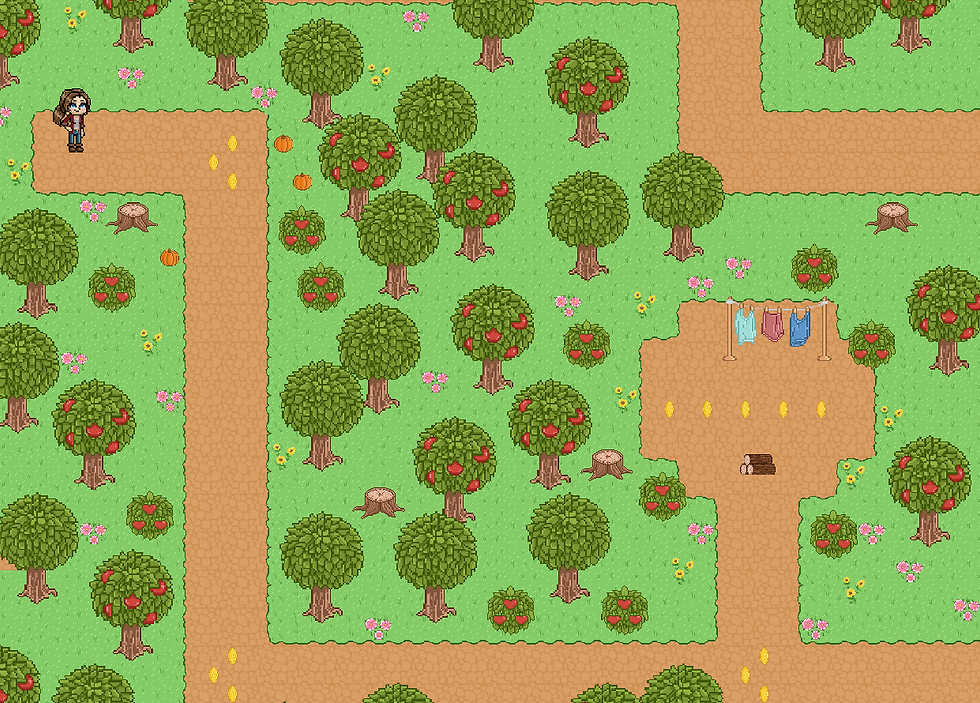

This level papermap was designed with the intention to combine adventure mechanics with a jigsaw puzzle to piece together the level. For this papermap, I needed to make sure there were icons for each interactable and a designated path for the player to follow.

This document details all of the information necessary to develop the game, Remember. In this document, I write about the visual style, the systems, and design of each level.
Purgatory
Purgatory is a 2-sided board game where the players compete to reach Heaven while avoiding Hell. When creating Purgatory, we kept in mind that while it's a family game, it was safe to assume that it wasn't suitable for all audiences.
Software: None (Board Game)


Game Design
Objective 2
Create and implement game elements, systems and play mechanics using industry-standard tools, techniques and production methods, including art or scripting/programming applications.
Project: Katalyst
Project: Katalyst is an indie title I am developing through Tongue-In-Cheek Productions as programming lead. Previously, the pictured environment was created as a demo of the art style while I was art lead for the project. Now, I make sure the programming team remains on track to complete a polished demo.
Software: Maya, Adobe Photoshop, Substance Painter/Designer, Unity


Listen
Listen is a game project created using C# in Unity. For this game, I wrote a procedural map generator, a sound manager (for the main mechanic, which was being blind), and custom UI art assets.
Software: Procreate, Maya, Unity (C#)

Somnia
Somnia is a game concept developed for my Student Innovation Project. This 3D level was created using 3D assets I created using Maya, Photoshop, and the Unreal Engine material editor. While the art is showcased in this image, I also demonstrate my C++/blueprinting skills as I continue to develop the final prototype.
Software: Maya, Adobe Photoshop, Substance Designer/Painter, Unreal Engine


Project Planner C# Application
This C# application was developed as a tool for me to use as a lead and producer. While it isn't a game, it was written with the intention to use for game development and required C# data algorithm skills to engineer.
Software: Visual Studio Code (C#)

Game Design
Objective 3
Demonstrate effective game design practices and techniques within the project scope and context, such as genre, style, platform and audience.
Brick by Brick
Brick by Brick is a single player adventure roguelite where you "doom scroll" to cater to the game's algorithm. When coming up with this idea for the GMTK game jam, my team and I made sure we catered as much as possible to our target audience. Since the game's mechanics relies a lot on current events and pop culture, we had to make sure we stuck with the humor that our target audience can connect with.


The GDD we created for Brick-by-Brick encompassed most of the game's work, as it contained all of the information necessary to connect the narrative with the roguelite mechanic.

When coming up with the concept of Brick by Brick, we made sure to include elements that related to our target audience as much as possible. For instance, one of the bosses, Zach, is an exaggerated character that follows the stereotype if a "crypto bro." Not everyone would know what that means except for the specific demographic the game was made for.
Steam Roll!
Steam Roll, in contrast to Purgatory, was a game build for fast-paced chaos. This board game was created for chaotic environments, whether it be within a family or at a party with drinking.


From start to finish, we wanted to keep the board relatively large to support enough space for 8 players. To suit the steam train theme while making the game fair, we gave the board 8 sides with an equal distance to the center.

Purgatory
Purgatory is a 2-sided board game where the players compete to reach Heaven while avoiding Hell. When creating Purgatory, we kept in mind that while it's a family game, it was safe to assume that it wasn't suitable for all audiences.

This image encompasses all of the prototyping and sketches we did related to Purgatory. With the target audience in mind, we assumed that most of our player-base would be college students with smaller spaces. Initially, we wanted a board that sat flat and would be flipped horizontally, but after prototyping it we realized that it would've taken up too much space. That, and the lack of resources, led us to the final product with a 2-sided, vertical board.
Game Design
Objective 4
Demonstrate the ability to evaluate game designs for a variety of gameplay mechanics, game applications and game genres.
Monster Hunter: World Game Design Analysis
For this game design analysis, I wanted to study the level design practices of Capcom's "Monster Hunter: World." My primary focus was on how each level/mechanic guides the player throughout the environment.
Since the point of the game is to find and hunt monsters depending on their unique travel mannerisms, the designers had to guide the player in a way to make the levels feel alive. In this analysis, I took screenshots and went into detail on the "Scoutfly" mechanic.


Semiotics in Destiny
Semiotics in video games, especially pertaining to design, is crucial to communicate with the player. In this analysis, I sketch over a still image of gameplay and discuss 6 different signs that communicate information to the player.
The designers in Destiny used a lot of icons to develop the player's vocabulary of the game. The skull icon shows them that they are in a no-respawn zone, for instance. Additionally, the weapon and ability icons share significant information on what the player has equipped. These are very simple examples, but they are important to understand and dissect when developing any game.

Controversial Narrative Topics Analysis
Sexism in video games has always been a controversial narrative topic, and since it's something I hold close to my heart, I wanted to analyze its practice thoroughly. For this analysis, I discuss how sexism is incredibly misunderstood when writing female characters, and how clothing should have little to do with how a character is written.
For instance, a well-written female character is someone who is strong and confident on their own accord, such as Bayonetta. In contrast, Zelda in "The Legend of Zelda: Echoes of Wisdom" did not feel like a strongly written character to me due to her primary goal being to save Link (to help save Hyrule). This is important to analyze as a game developer in modern times, as we constantly need to cater to an audience.


Best & Worst Level Design Analysis
When analyzing game design, looking at both the good and the bad is important so that you know how to replicate the good. In this breakdown, I look at both the "Coral Highlands" from Monster Hunter: World and "The Cauldron" from Destiny.
What I liked about the Coral Highlands was how well-staged the lighting was to help the player determine their height in relation to the level. What was poorly designed with the level was the agency, as players could only travel to higher points of the level through a single vine.
As for The Cauldron, the flow and pacing of the level for a multiplayer game were astronomical. While there wasn't much variation in verticality, there were plenty of tunnels and platforms to give the players plenty of choice on how they play.


Game Design
Objective 5
Effectively articulate game design elements and mechanics across disciplines utilizing written and verbal communication skills.
Somnia
Somnia is a game concept developed for my Student Innovation Project. This game design document contains all the information necessary for the game design, mechanics, and art style. Not only that, but since the game relies solely on current topics and social media practices, there is a page dedicated solely to live stream research.
The content is organized cohesively and within the format I set as the product owner.
Link: https://docs.google.com/document/d/1OpCkGddsl6qeqQ0QgkGT_wkaU486hisW_P8tCMkaV5k/edit?usp=sharing

Listen
Listen was a project I worked on for two different classes, and this document details all of the necessary information needed to develop it for my programming class. It contains not only mechanics, UX, and research, but also an art style guide that I was able to follow as a multifaceted developer.


Project: Katalyst
Project: Katalyst is an indie title I am developing through Tongue-In-Cheek Productions as programming lead. At the beginning of my time as a lead on the project, all game design documents were composed separately and were difficult to find. I took the executive decision to form a single document with proper formatting and sectioning, which the team continues to use to this day.

Game Design
Objective 6
Establish collaboration, mentorship and professional leadership skills by working with other disciplines to deliver highly polished and completed projects.
Tongue In Cheek productions LLC
Summer 2025 - Present
For Tongue In Cheek, I have been working as art lead, co-producer, and programming lead for our upcoming title, Project: Katalyst. Since I have experience with the 3 majors, I often bounce around between disciplines to ensure development is moving smoothly. While the project isn't completed (yet), we have developed several demo titles to show off the hard work we have done.
Role: Art Lead & Programming Lead


Unite the Valley Game Jam
Fall 2025
The 2025 Unite the Valley Game Jam hosted by Unity was the first of its kind in Arizona. For this project, I worked with a team of 5 to develop a game that demonstrated our collaborative skills within rules and constraints for the competition.
Role: C# Programmer & Designer

GMTK Game Jam
Summer 2025
For the GMTK game jam hosted by the UAT IGDA, I worked on a team of 5 to develop a full game called "Brick by Brick." My role was to hold my weight as a designer, but also help program data structures for the innovative mechanics of a doom-scrolling roguelike.
Role: C# Programmer & Designer


UAT IGDA Chair
Summer 2025 - Present
As the Chairman of the UAT chapter of the IGDA, I host monthly meetings to help mentor students to be as successful as possible in the industry. We've done events for each discipline, such as hosted game jams and presentations for level design, but also helped students acquire networking skills to help land them a job in their desired fields.
Role: Chair

Purgatory Board Game
Summer 2023
Purgatory is a 6-player board game where players must randomize & strategize to reach heaven whilst avoiding hell. On this team, I served as the primary product owner while helping with other pieces of the project, such as board art and mechanical design.
Role: Product Owner, Artist, & Designer

Art Jam
Fall 2024
For an art jam, I got with a team of 3 to create a 2D art piece that fell within the thematic constraint of "Halloween." We collaborated by creating our characters, and I tied the whole piece together by rendering the artwork with a background and post-processing.

SIP - Somnia


Somnia aims to integrate a prototype that provides a unique experience inspired by previously existing adventure game titles through live-stream related mechanics.
These systems include a viewer count that changes depending on the player’s in-game actions, a chat that reacts to the player’s choices, and it will be a place where the player can have a live-streaming identity attached to a virtual world.
Somnia's goal is to reach a niche audience that is familiar with content creation and empower them in interactive and moral ways. The result of the innovation is to prove that the mechanic is fun and meaningful to the niche audience, live streamers, and fans of adventure games.

